.


Welcome to the website for the Allen Institute for Immunology-University of California San Diego-University of Colorado Transition to Rheumatoid Arthritis Project (ALTRA)
The project is called 'ALTRA', and its goal is to identify ways to improve how RA is diagnosed and treated - and even find ways to prevent disease. In addition, this project is part of a larger collaborative effort through the Allen Institute for Immunology to understand how the immune system functions in health and other diseases including cancer and inflammatory bowel disease.
Read more below on RA, and how you may be able to participate in the ALTRA project!
What is RA?
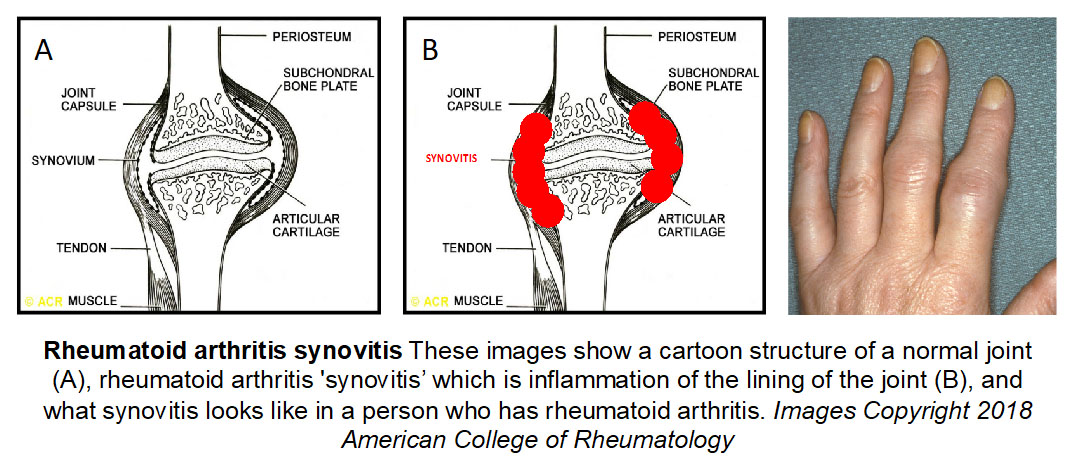
RA is a disease in which the immune system attacks the joints, leading to joint inflammation called synovitis. When a person has the synovitis of RA, their joints can feel painful, stiff and swollen (Figure).
Who gets RA?
RA is present in about 1% of the general population and affects around 3 million people in the United States. A higher rate of RA (~5%) may be seen in people who have a first degree relative with RA, such as a sibling or parent. Rheumatoid arthritis is also more common in women.
How is RA diagnosed?
RA is diagnosed when an individual has a combination of joint symptoms, joint swelling/synovitis on a joint examination, x-ray findings, and abnormal blood tests. This can be termed ‘full-blown’ RA: and it is generally diagnosed by a rheumatologist, a specialist in arthritis.
What blood tests are used to diagnose RA?
The most common blood tests used to diagnose RA are called ‘autoantibody tests’. Normally, antibodies are proteins made by your body to help attack things that your body thinks are foreign or threatening, like infections. Sometimes, however, ‘autoantibodies’ develop that attack parts of your own body. In RA, two common autoantibodies found in the blood are ‘anti-CCP’ and rheumatoid factor. Of these two, anti-CCP is the most accurate for a diagnosis of RA.
A simple blood test can indicate future risk for developing RA
Anti-CCP can be present in the blood on-average 3-5 years before the synovitis of RA develops. The time between when anti-CCP is detected in the blood and the development of joint inflammation of RA can be called “Pre-RA”. This means that blood levels of anti-CCP can be used to identify people who are at risk of developing RA in the future, even if they currently do not have synovitis. Current research shows that people with high levels of anti-CCP have a 30-50% chance of developing RA within 3-5 years. This also means that some people with anti-CCP antibodies do not develop RA. The ALTRA Project is focused on understanding Pre-RA and in particular on understanding how RA may develop in individuals who have abnormal blood levels of anti-CCP. In addition, the ALTRA project hopes to identify new ways to treat RA, or even prevent future disease.
How can you participate in the ALTRA Project?
-
If you are 18 or older and do not have a diagnosis of RA you can be tested for anti-CCP for this research study.
You can get this anti-CCP test performed for free at one of the ALTRA Project's study sites at the University of California San Diego in San Diego, California, or the University of Colorado Anschutz Medical Campus in Aurora, Colorado.
Of note, the ALTRA Project will test anyone 18 years or older who does not already have RA for anti-CCP. However, because RA can run in families, we are particularly interested in testing anti-CCP in family members of people who have RA.
OR
-
If you have already had an abnormal anti-CCP test, but your healthcare provider doesn't think you have full-blown RA, you could also participate in the ALTRA Project.
If this applies to you, please contact the ALTRA Project and schedule a repeat test for anti-CCP to see if you qualify for the study.
If you are found to have a high blood level of the anti-CCP test through testing by the ALTRA Project, meet other study qualifications, and decide to enroll in the study, you would be evaluated at several visits every year for up to 3 years.
At each visit you will:
- Complete questionairres
- Undergo a blood draw
- Potentially have a flu vaccine annually given to you for free as part of the study
-
Receive a modest compensation
(If you develop RA during the study, you will be referred to an arthritis specialist for clinical care.)
For more information on how to participate in the ALTRA Project, please see below:
If you are in the San Diego, California area
contact us via form or phone.
The Principal Investigator at the University of California San Diego is Dr. Gary Firestein (IRB #19-1150)
If you are in the Denver, Colorado area
contact us via form or phone.
The Principal Investigator at the University of Colorado is Dr. Kevin Deane (IRB #19-1150)
 English
  Spanish